
MARKET DEVELOPMENT
Bio-fueled: County’s Used Cooking Oils Becoming Cleaner Diesel
Bio-fueled: County’s Used Cooking Oils Becoming Cleaner Diesel
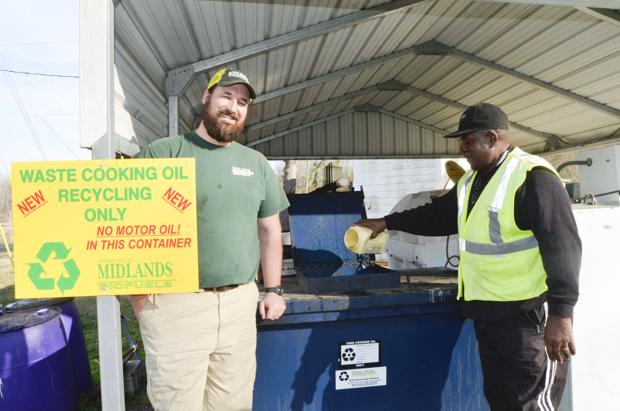
Matt Renwick, left, of Midlands Biofuels looks on as county employee Marion Wolfe pours a container of cooking oil into a recycling bin at Orangeburg County’s Glover Street convenience site.
02/01/2014 (The Times and Democrat) - Cooking oils are used for many things: baking, frying, sauteing and dressings.
About 10,000 gallons of cooking oil are discarded in Orangeburg County annually, says Joe Renwick, founder and process engineer for Winnsboro-based Midlands Biofuels LLC.
“If this cooking oil wasn’t collected, people would just pour it out in the backyard or pour it down the drain, which causes thousands of dollars in damage each year,” Renwick said.
Midlands Biofuels has contracted with Orangeburg County to recycle cooking oil at each of the county’s 21 convenience sites.
Orangeburg County Council approved the year contract in October. The contract can be renewed according to its success and need for the service.
“It is just another way the county is trying to recycle some of the waste material that the citizens of Orangeburg County have to deal with,” Orangeburg County Public Works Director Sinkler Boone said. “Joe is a reputable dealer and I think he will do good for the county.”
Under the contract, Midlands Biofuels is responsible for providing collection containers, servicing them regularly and paying for the oil collected. The county is not charged for the pickup and receives 90 cents per gallon for the cooking oil collected. The oil is collected at least on a monthly basis.
Midlands picks up the cooking oil and transports it to Winnsboro for processing into biodiesel.
“For every gallon of oil collected, one gallon of biodiesel can be made,” Renwick said. “This fuel can be used in any diesel engine without modification.”
Renwick said the fuel burns about 86 percent cleaner than traditional diesel, eliminating black smoke and decreasing friction -- which preserves engine life.
Since services began Nov. 1, about 2,000 gallons of cooking oil have been collected in the county.
Cooking oil can include a variety of oils including olive, palm, soybean, canola, pumpkin seed, corn, sunflower, safflower, peanut, grape seed, sesame, argan, rice bran and other vegetable oils.