
Indigenous Dayak sound alarm as palm oil firm razes orangutan habitat in Borneo
Mongabay (02/12/2025) - KAPUAS HULU, Indonesia — A palm oil company is rapidly clearing rainforest inside a UNESCO Biosphere Reserve that’s home to orangutans and sun bears, adding to concerns over Indonesia’s efforts to curb deforestation.
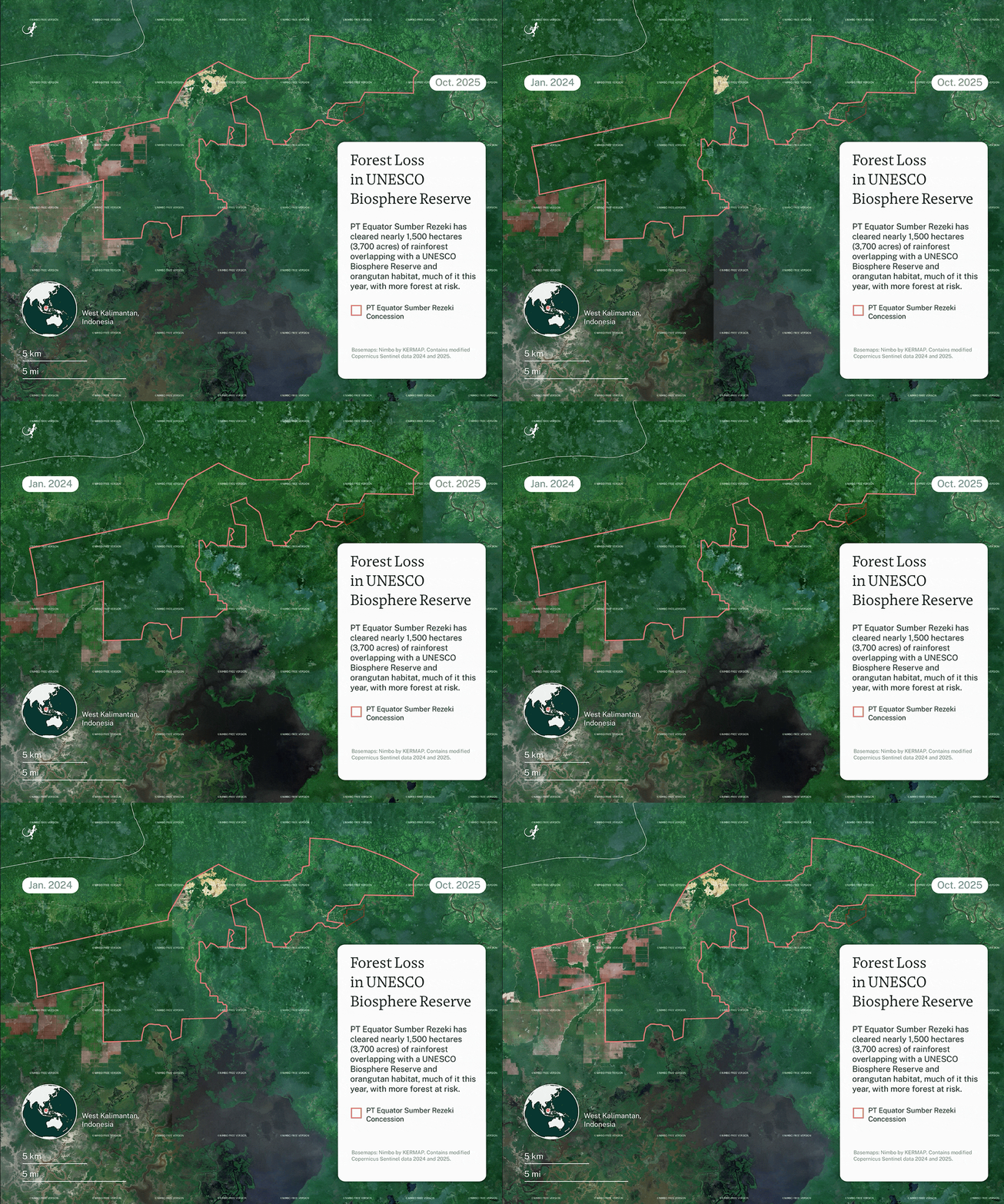
The company, PT Equator Sumber Rezeki (ESR), is a subsidiary of the Jakarta-based First Borneo Group, owned by Indonesian tycoon Alexander Thaslim. It has cleared nearly 1,500 hectares (3,700 acres) of rainforest since it began operating last year in Kapuas Hulu, a landlocked district deep in Indonesia’s West Kalimantan province on the island of Borneo, near the border with Malaysia.
ESR’s 15,000-hectare (37,000-acre) oil palm plantation concession overlaps with part of the Labian–Leboyan watershed, a wildlife corridor connecting Betung Kerihun and Danau Sentarum national parks — two of the last strongholds for the critically endangered Bornean orangutan (Pongo pygmaeus).
Conservationists estimate that as much as 80% of the concession area contains rainforest deemed of high conservation value, making it especially vital to protect. Orangutans inhabit about a quarter of the concession, according to a government-backed study from 2016.
The corridor and parks form part of the Betung Kerihun–Danau Sentarum Biosphere Reserve, designated by UNESCO in 2018. Its forests sustain hundreds of species of fish, birds and mammals, including rare hornbills and giant rafflesia flowers, and provide water, food and livelihoods for Indigenous Dayak communities whose cultures are deeply tied to the land.

Despite the rich rainforest, the area isn’t zoned as a “forest area” in Indonesia’s official land-use maps, making it eligible for development.
According to satellite analysis, ESR clear-cut 1,376 hectares (3,400 acres) of forest between January and August 2025, a massive spike from the 195 hectares (482 acres) it cleared in all of 2024, when its operations appear to have begun. In total, around 3,000 hectares (7,400 acres) have now been cleared of rainforest or other vegetation — roughly a fifth of the concession — suggesting far more forest loss may soon follow.
If that happens, it would contribute to an increase in Indonesia’s deforestation rate since 2021, after half a decade in which the rate fell sharply after then-President Joko Widodo temporarily froze the issuance of permits for new oil palm plantations.
“What’s happening in West Kalimantan indicates that palm oil deforestation will continue,” Hilman Afif, a forest campaigner with Auriga Nusantara, a conservation NGO, told Mongabay. “ESR has only just begun clearing land, meaning the deforestation footprint is likely to expand far beyond what we’re seeing today.”
Allegations of land grabbing
After NGOs raised the alarm about ESR’s activities earlier this year, Mongabay traveled to the area in September to speak with affected communities and witness the deforestation firsthand.
We met Banying, 62, an elder in a local Dayak Iban community, at a traditional longhouse in Setulang, a village surrounded by rainforest lying within ESR’s concession. Large animals, he told Mongabay, were fleeing the destruction of their forest homes in the territory of neighboring Senunuk village, coming into more frequent contact with people in Setulang.
“Already we see bears often near houses,” Banying said. “The small black bears eat fruits like rambutan and durian. Orangutans are also increasingly seen down the road.”
ESR has yet enter Setulang’s territory, but the company, Banying said, is expected to start operating in the village this year on a tract of 437 hectares (1,080 acres) that’s been leased to the firm.
“This year they plan to clear it with heavy equipment,” he said. “If that forest is cleared, they [bears and orangutans] may move here, since they’ll have no place left there.”
Senunuk and Setulang villages have entered into voluntary agreements with ESR to let it plant chunks of their territory with oil palm trees. Banying said that given the scarcity of local jobs and the precarity of rice farming, many locals were swayed by the company’s offer of 1 million rupiah ($60) per hectare (about $24 per acre) in exchange for 30-year usage rights. Only a relatively small area, Banying said, or at least smaller than what ESR had asked for, had been handed over to the firm.
Three other villages — Labian, Labian Ira’ang and Mensiau — also fall within ESR’s concession. However, leaders from Labian and Labian Ira’ang told Mongabay they never agreed to let ESR use their land, and that they were shocked to learn that parts of their territory had been included in the firm’s license area without their knowledge or consent. Mongabay was unable to meet with anyone from Mensiau.
Robertus, the head of Ngaung Keruh hamlet in Labian village, said company officials first appeared in their community in mid-2025, asking local leaders for permission to survey the forest. The officials claimed to have papers showing the village’s territory had been included in the operational zone identified in the plantation business permit, or IUP, issued by the district government.
“The company brought institutional backing, and apparently they already had an Amdal [environmental impact assessment], which said that Labian village territory was already demarcated and included in the company’s land-use permit,” Robertus said. “Yet the company had never [previously] come to my hamlet. I was confused.”
Locals rejected the company officials out of hand, said Bernadus Nandung, the head of Ukit-Ukit hamlet in Labian.
“Before they even explained, the village leaders said any activity related to oil palm is not accepted here,” Bernadus told Mongabay at his home in the village. “We were afraid that if we signed anything, it would be misused.”
To qualify for an IUP, a palm oil firm must first get permission to use an area from local landowners. In practice, companies often bypass key steps of the licensing process with impunity, said Hilman, the Auriga campaigner, and rainforests that should be protected are bulldozed. “We still see community conflicts, orangutan habitat destruction, and permits issued right next to national parks,” he said.
Villagers questioned how their lands could have been officially zoned for development when they were still covered with intact forest hosting wildlife like orangutans.
“I don’t know when [our village was zoned for development] — it was never explained,” Antonius Leo, a 66-year-old temenggong, a type of customary leader, in Labian Ira’ang village, told Mongabay. “That’s why I’m angry.”
Hilman said the area should never have been made eligible for plantation development, given that the government’s own orangutan conservation strategy clearly maps the area as critical orangutan habitat. Allowing the company to operate here also contradicts government climate commitments to turn the country’s forests into a net carbon sink by 2030, he said.
“This calls into question the government’s seriousness about orangutan protection,” Hilman said.
The 81,000-hectare (200,200-acre) Labian-Leboyan watershed is home to an estimated 2,470 orangutans.
“It’s impossible that officials don’t know this is a buffer zone for the national parks, yet they still issue oil palm permits [here],” said Bernadus, the Ukit-Ukit hamlet chief. “It makes no sense.”
Mongabay reached out to First Borneo, the district government of Kapuas Hulu, and the Ministry of Forestry for comment, but none responded by the time this article was published.
Invisible Indigenous
To defend their lands, Labian villagers have tried for years to secure government recognition of their Indigenous territory and rainforest.
Indonesia’s Constitutional Court ruled in 2012 that Indigenous peoples’ customary forests are not state property but belong to the communities themselves. But in order for their forests to be recognized as such, communities must first undergo a lengthy and costly process entailing mountains of paperwork and lobbying local and national officials to issue the necessary approvals.
Ngaung Keruh, the Labian village hamlet, secured decrees recognizing its customary territory in 2023 and forest in 2025.
“These give us legal standing and we feel more at ease,” said Robertus, the hamlet leader.
But other applications remain pending, with two other Labian hamlets, Tumbali and Ukit-Ukit, still trying to navigate a process they initiated in 2018 and 2022, respectively.
Nationally, around 332,500 hectares (821,600 acres) of customary forests have been recognized, Forestry Minister Raja Juli Antoni said recently. That’s far short of the more than 23 million of hectares (57 million acres) of customary forests mapped by an independent initiative called the Ancestral Domain Registration Agency (BRWA) — leaving Indigenous communities like the ones in Kapuas Hulu vulnerable to land grabs.
“We want recognition of [our] customary forest so there’s no more threat from the government, because it’s the government that gives permission to companies [to clear our lands],” said Bernadus, the Ukit-Ukit leader.
‘Sustainable’ palm oil?
First Borneo, the ESR parent conglomerate, is tearing down rainforest in several parts of Kapuas Hulu district.
As of April this year, two other First Borneo subsidiaries, PT Borneo Internasional Anugerah (BIA) and PT Khatulistiwa Agro Abadi (KAA), had cleared 7,315 and 6,809 hectares (18,076 and 16,825 acres), respectively, of rainforest, according to Auriga.
With many of the world’s biggest firms that refine, trade and use palm oil pledging to stop doing business with planters that clear rainforest, First Borneo has already landed on many companies’ “no-buy” lists.
However, First Borneo’s palm oil is still making its way into the supply chains of companies that have issued zero-deforestation pledges, according to Phil Aikman, campaign director at U.S.-based NGO Mighty Earth.
First Borneo’s Kapuas Hulu plantations are selling their palm fruit to a pair of mills owned by the Sabeni Group, PT Samboja Inti Perkasa (SIP) and PT Permata Subur Lestari (PSL), that in turn sell crude palm oil to refiners that have committed to purging their supply chains of deforestation.
“This demonstrates that the No Buy positions on First Borneo is more of a ‘request’ than a strict enforcement order,” Aikman told Mongabay in an email.
Alexander Thaslim, the Indonesian tycoon, is the largest beneficial shareholder in all three of the First Borneo concessions in West Kalimantan, according to Mighty Earth.
To ensure that the palm fruit cultivated by First Borneo’s Kapuas Hulu plantations doesn’t enter zero-deforestation supply chains, Aikman said Mighty Earth has engaged with palm oil refiners to get the Sabeni Group to clean up its act or be suspended by the industry.
Some refiners, such as Wilmar International, one of the world’s largest food companies, have engaged with their supplier mills that buy palm fruit from First Borneo.
Wilmar’s engagement followed a complaint lodged by Mighty Earth and a Mongabay article in April 2025 alleging that SIP was buying palm fruit from BIA and KAA. Following Wilmar’s engagement, SIP decided to cease sourcing from both concessions effective Aug. 4, 2025.
Another palm oil refiner, Apical, has also received a complaint from Mighty Earth that its supplier, PSL, was sourcing palm fruit from BIA and KAA.
Like Wilmar, Apical responded to the complaint by requesting PSL stop sourcing from BIA immediately, and on Sept. 25 PSL announced to its buyers that it had done so. However, PSL is still buying palm fruit from KAA, Aikman said.
“We continue to push Apical on this, as Apical has the main contract with PSL and everyone else buys PSL’s [crude palm oil] through Apical,” he said.
What needs to be done
With the survival of unique communities, fragile ecosystems and threatened wildlife at stake, environmentalists are calling for regulators to step in against ESR.
Aikman said the Ministry of Forestry should issue a stop-work order, as it did to another plantation company, PT Mayawana Persada, that spent years bulldozing carbon-rich peatlands that were also home to orangutans in West Kalimantan’s Ketapang district.
“There are probably similar cases throughout Indonesia, where the forestry ministry needs to pull companies back on their development plans,” Aikman said.
Hilman went a step further, calling on the government to cancel ESR’s permits.
“If the permits are under district authority, they should revoke them, because ESR is both sparking conflicts and destroying orangutan habitat near Lake Sentarum, which is an ecological icon of West Kalimantan,” he said.
The Ministry of Forestry, Hilman added, should push for the three First Borneo concessions to be designated as protected areas due to the orangutans living there.
All these can be done while still developing Indonesia’s palm oil industry, which is already the world’s biggest, Aikman said, adding that Indonesia should follow Malaysia’s example and cap its total oil palm area while focusing on improving smallholder yields.
An uncertain future
For now, Kapuas Hulu’s forests remain contested. ESR is still mapping its concession boundaries in preparation for an HGU permit, the final step before full-scale plantation development can legally begin.
Indigenous leaders say the stakes are nothing less than cultural survival.
“If the forest is destroyed, it’s we who suffer,” Bernadus said. “We cannot live without springs. Springs provide water for everything. If they are replaced with oil palm, Kalimantan won’t be Kalimantan anymore. Springs won’t be springs anymore, but tears.”
He added that the forest is bound up with Dayak cultural life.
“When someone dies, we take wood for the coffin and rattan [from the forest] to tie it together,” Bernadus said. “Resin is used as an adhesive. For respected people, the coffin must use carved wood. That’s why the forest must never be lost.”
Read more at https://news.mongabay.com/2025/12/indigenous-dayak-sound-alarm-as-palm-oil-firm-razes-orangutan-habitat-in-borneo/